
Knife skills come before speed. Ask any chef what separates a beginner from someone who looks professional and many will say: the knife. Not speed, but control. This guide covers the basics from the American Heart Association’s Knife Skills 101, which draws on guidance from the Culinary Institute of America.
Which knives to buy first
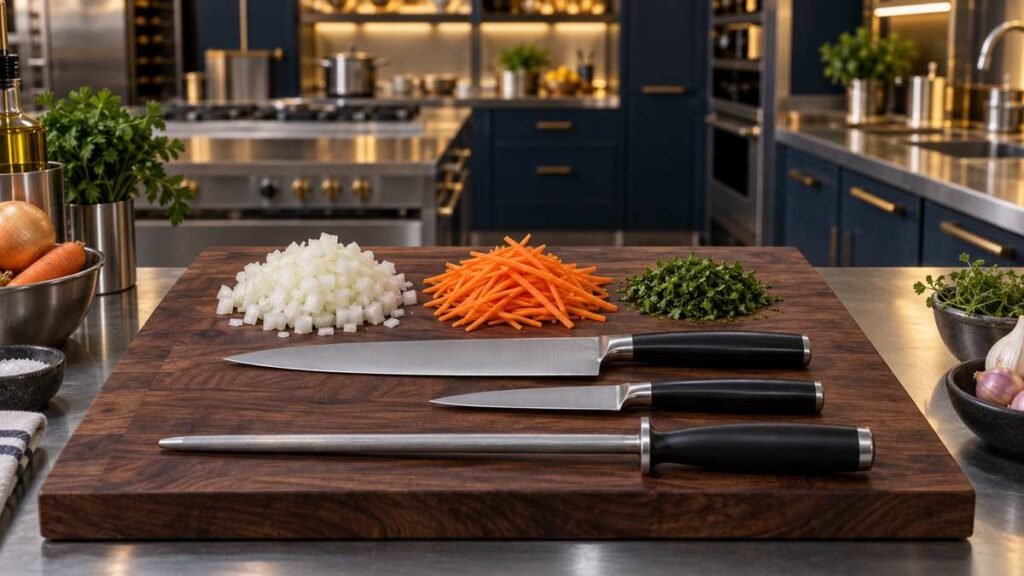
If you can afford only one knife, the AHA suggests a chef’s knife, usually 8 or 10 inches, because it handles many jobs. A good second knife is a paring knife, which is smaller and suited to peeling and cutting small, delicate foods.
A sharp knife is a safe knife
It sounds backwards, but the guide says a very sharp knife is safer. It cuts smoothly with less pressure from your hand than a dull one, so it is less likely to slip.
How to hold a chef’s knife
The guide lists four ways of handling a knife, from the Culinary Institute of America:
- Grip the handle with all four fingers and hold the thumb gently but firmly against the spine of the blade.
- Grip the handle with all four fingers and hold the thumb against the side of the blade.
- Grip with three fingers, rest the index finger flat against one side of the blade, and the thumb on the opposite side for extra stability and control.
- Grip the handle overhand with the knife held vertically. This is for boning knife tasks in meat fabrication.
Knife skills vocabulary: cut names and sizes
Learning the cut names is part of the daily language of knife skills in a professional kitchen.
| Cut | What it means |
|---|---|
| Chop | A chunky cut. “Coarsely chop” means bigger pieces |
| Dice | Smaller than a chop, usually less than half-inch cubes, the size of playing dice. Sometimes called finely chopped. Diced foods cook faster than chopped |
| Mince | Tiny pieces, often for garlic, onions and fresh ginger |
| Julienne | Long, thin matchsticks, often for carrots or leafy herbs such as basil |
Always follow the size in the recipe. Evenly cut pieces cook evenly.
Safety habits that stick
- Keep hands dry before using a knife so it does not slip.
- Put a towel between the cutting board and the counter so the board stays still.
- Use the right knife for the job: paring knife for peeling and coring, chef’s knife for chopping and slicing.
- On the hand holding the food, curl the fingers under and move the hand along as you cut.
- Do not get distracted. If you drop a knife, step back and let it fall. Do not try to catch it.
- Never put a knife in a sink full of water. Someone could reach in and be cut.
- Do not put knives in the dishwasher. Wash by hand separately and dry completely.
- Do not leave knives loose in a drawer unless they are in a sheath. Store them safely.
A beginner’s knife skills practice plan
- Week 1: grip and claw hand with onions and carrots, slowly.
- Week 2: even dice. Aim for same-size pieces, not speed.
- Week 3: mince garlic and herbs, and julienne a carrot.
- Week 4: set a timer and see how your control holds as you speed up.
Frequently asked questions about knife skills
Is a dull knife safer for beginners? The guide says the opposite: a very sharp knife is safer.
Chop or dice? Dice is smaller and more uniform. Chop is chunkier.
Learn with Rufford College
Explore Rufford College Culinary Arts, from everyday cooking to professional technique. Explore the Culinary faculty.