
Good kitchen food safety starts with a simple fact: you cannot see, smell or taste the bacteria that cause food poisoning. That is why every professional kitchen runs on rules, not on guesses. This guide summarises the four-step approach from the US Department of Agriculture’s Food Safety and Inspection Service (FSIS). The temperatures come from that US source, shown in both Fahrenheit and Celsius. Check the rules in your own country, because limits can differ, and professional kitchens follow local law.
The four steps of kitchen food safety
- Clean: wash hands and surfaces often.
- Separate: do not cross-contaminate.
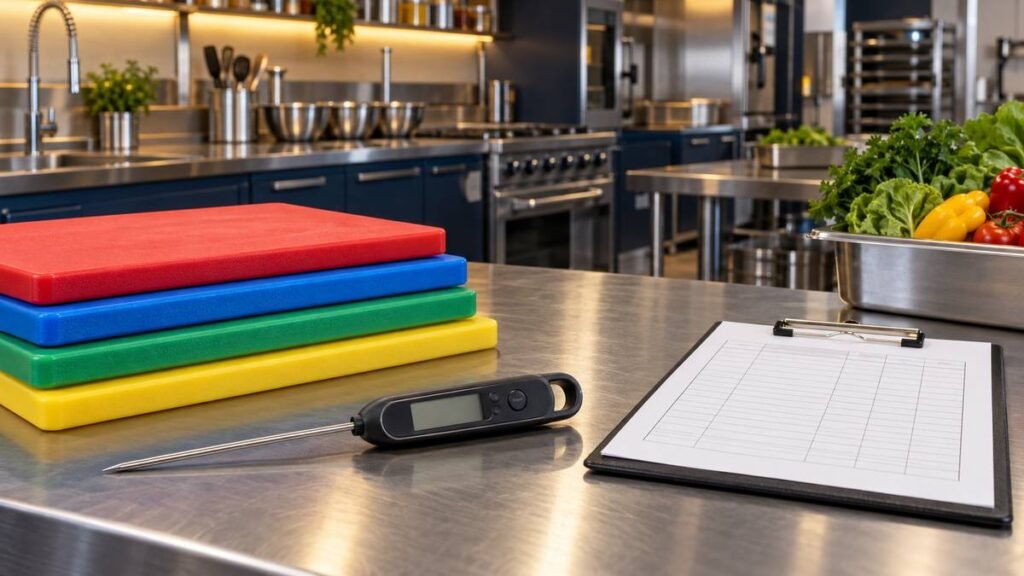
- Cook: cook to proper temperatures, checking with a food thermometer.
- Chill: refrigerate promptly.
Clean
Always wash hands with soap and warm water for 20 seconds before and after handling food. After cutting raw meat, wash the cutting board, knife and counter with hot, soapy water. FSIS also describes sanitising cutting boards with 1 tablespoon of unscented liquid chlorine bleach in 1 gallon of water.
Separate
Keep raw meat, poultry, fish and their juices away from other food. At the shop, choose refrigerated or frozen items last and never choose meat or poultry in torn or leaking packaging. At home, wrap perishable meat securely so juices do not touch other food, and marinate in a covered dish in the refrigerator.
Cook: the numbers
| Food | Minimum internal temperature |
|---|---|
| Beef, pork, lamb and veal steaks, chops, roasts | 145 °F (63 °C), then rest at least 3 minutes |
| Ground beef, pork, lamb and veal | 160 °F (71 °C) |
| Poultry | 165 °F (74 °C) |
FSIS says to measure with a food thermometer before taking food off the heat. Celsius values are converted from the Fahrenheit figures in the source and rounded.
Chill: storage and serving
Cold storage is the quiet half of kitchen food safety: it buys time, it does not sterilise.
- Refrigerate perishable food within 2 hours, or within 1 hour when the temperature is above 90 °F (32 °C).
- Refrigerator at 40 °F (4 °C) or below. Freezer at 0 °F (-18 °C) or below. Check with an appliance thermometer.
- Cook or freeze fresh poultry, fish, ground meats and variety meats within 2 days. Other beef, veal, lamb or pork within 3 to 5 days.
- Hot food should be held at 140 °F (60 °C) or warmer. Cold food at 40 °F (4 °C) or colder.
- Perishable food should not be left out for more than 2 hours (1 hour above 90 °F).
- At a buffet, keep hot food hot with chafing dishes or warming trays and cold food cold in ice, using small trays that are replaced often.
Thawing safely
FSIS describes three safe methods: in the refrigerator, in cold water (in a leak-proof bag, changing the water every 30 minutes, and cooking immediately), or in the microwave (and cooking immediately).
Common kitchen food safety mistakes
- Cooking by colour instead of using a thermometer.
- Using the same board for raw chicken and salad.
- Leaving food out through a long meal.
- Not checking the fridge temperature.
Frequently asked questions about kitchen food safety
Are these numbers the same in the UK? They come from a US government source. Local rules can differ, so professional kitchens should follow their own country’s guidance.
Why rest meat? FSIS says to rest steaks, chops and roasts for at least three minutes for safety and quality.
Learn with Rufford College
Explore Rufford College Culinary Arts, from everyday cooking to professional technique. Explore the Culinary faculty.