
Blood sampling is a core clinical skill, and this article is general education only. It is not medical advice, it does not replace a doctor or other qualified professional, and it does not teach you to treat or perform procedures on yourself or others. In an emergency, call your local emergency number (999 in the UK). This article explains safety principles only. It does not teach how to insert a needle. Blood sampling must be learned under qualified supervision.
Most people think of drawing blood as a technical skill with a needle. The World Health Organization sees it just as much as a safety system: protect the patient, protect the worker and protect the community. This article summarises the safety principles in chapter 8 of the WHO Guidelines on Drawing Blood (2010).
Three guiding principles of blood sampling
The guidelines rest on three ideas:
- Safe practice should follow evidence-based principles.
- Every phlebotomy service should, within its capacity, work towards best practice.
- Health workers should be protected and allowed to work in a safe environment, with knowledge that reduces harm to themselves, patients and the community.
Protection of the worker
WHO recommends that health workers wear well-fitting, non-sterile gloves when taking blood, for every procedure, and that they perform hand hygiene before and after each patient procedure and before putting on and after removing gloves. Gloves are changed between patients. Masks, visors and eye protection may also be needed if extra blood exposure is expected, for example in arterial sampling.
Equipment
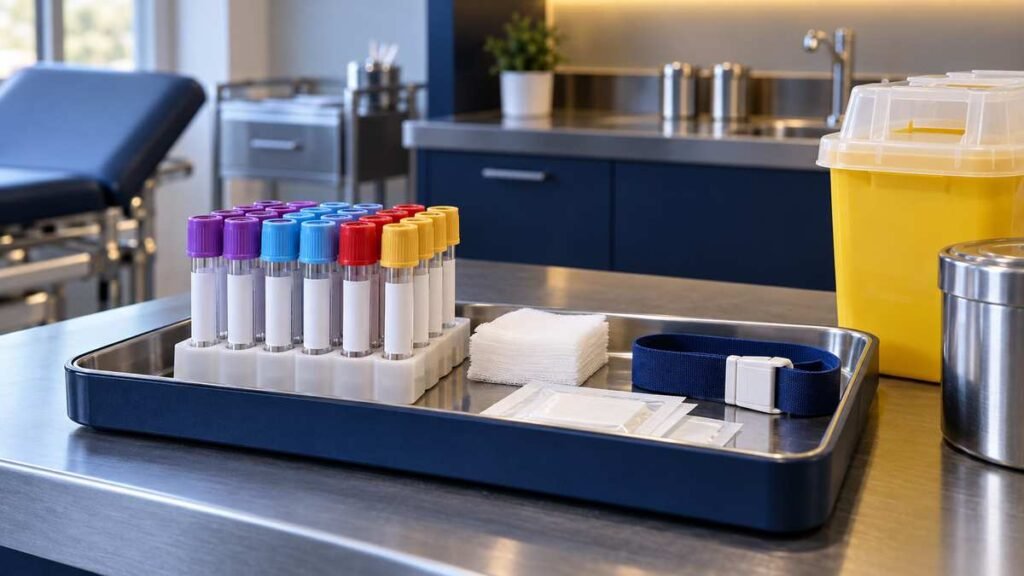
The guidelines say safety-engineered evacuated tube systems or winged needle sets are safer than a hypodermic needle and syringe, though all are effective for blood sampling. Safety features such as needle covers or retractable lancets reduce risks from recapping and transfer. A sterile, single-use needle and syringe should be used for each patient and placed into a sharps container as one unit right after use. Capillary punctures should use a sterile device, preferably one whose lancet retracts automatically, to prevent reuse and sharps injuries.
Blood sampling training
All health workers who draw blood must be trained in infection prevention and control and must show proficiency in the specific methods they will use, for example adult, paediatric, venous, arterial or capillary sampling. WHO recommends regular in-service training and supervision, theory and practical knowledge, and a certificate of competence after successful demonstration.
Sharps disposal
The device should be disposed of immediately after use as a single unit into a puncture-proof, leak-proof, closable sharps container that is clearly visible and within arm’s reach. WHO points to needle recapping, decanting, recycling and overfilling of sharps containers as causes of needle-stick injuries.
Infection control checklist
WHO lists the measures that help prevent health care-associated infections:
- hand hygiene
- glove use
- skin antisepsis
- sterile, single-use blood-sampling devices
- sharps containers
- disinfection of surfaces and chairs
- cleaning and disinfection of tourniquets and other reusable items
Items used on more than one patient must be designed so they can be cleaned and disinfected.
What learners should take from this
Good technique with a needle is only half of safe blood sampling. The other half is preparation, personal protection, single-use equipment and safe disposal. Employers also have a duty to provide the equipment.
Frequently asked questions about blood sampling
Do gloves replace hand hygiene? No. WHO says hand hygiene before and after each procedure and around gloves.
Can I learn this from an article? No. Practical blood sampling requires supervised training and proof of competence, which is not the same as an online course.
Learn with Rufford College
Our venepuncture course teaches safe practice with practical skills testing, live online in Arabic or English. See our Medicine and Healthcare courses.